Essential Tax Deadlines and Compliance Requirements for April 2026
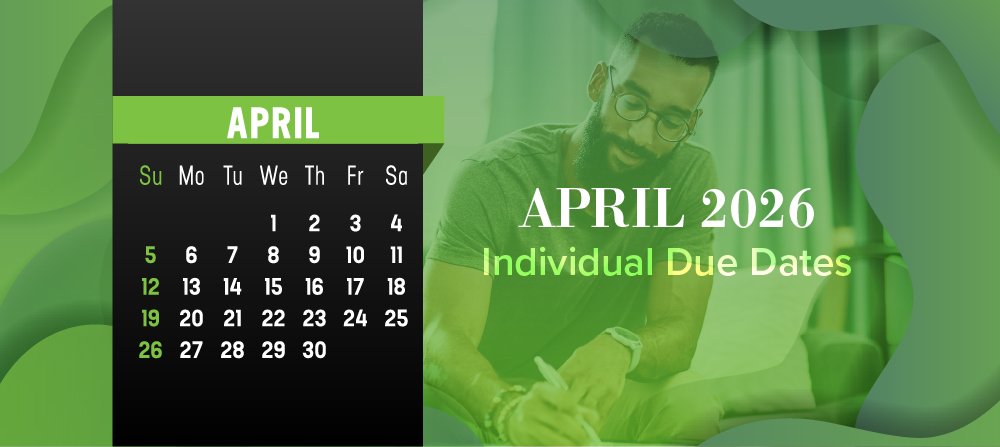
Navigating the Mid-April Tax Landscape
For individuals and small business owners alike, April is often the most demanding month on the financial calendar. Beyond the well-known deadline for income tax returns, several other compliance requirements and contribution windows converge mid-month. Whether you are managing personal wealth or overseeing the growth of a business with $500K to $5M in revenue, staying organized is the only way to avoid unnecessary penalties and interest. At Integrated Accounting Solutions (IAS), we view this period as the 'Super Bowl' for your books—a time when meticulous record-keeping and proactive planning pay dividends.
April 10: Reporting Tips to Your Employer
If your professional role involves earning tips, the IRS maintains specific reporting standards that must be met monthly. Any employee who received $20 or more in tips during the month of March is required to report that total to their employer by April 10. Accuracy here is vital, as this information dictates your tax withholding. To satisfy this requirement, you may utilize IRS Form 4070 or provide a signed written statement. This statement must include your name, address, Social Security number, the establishment's name, the specific period covered, and the total tip amount received.
Once reported, your employer is tasked with withholding FICA and income taxes from your standard wages to cover the tip income. In instances where your regular wages do not fully cover these withholding requirements, the remaining balance will be documented in Box 8 of your W-2 at the end of the year. It is important to remember that you will be responsible for paying this uncollected withholding when you file your annual tax return, making mid-year cash flow management essential.
April 15: Compliance for Taxpayers with Foreign Financial Interests
Global financial interests bring a unique set of reporting obligations. Any U.S. citizen, resident, or person conducting business within the United States who holds signature authority or financial interest in foreign accounts—including bank accounts, securities, or other financial holdings—must file Form FinCEN 114, commonly known as the FBAR. This requirement is triggered if the aggregate value of these foreign accounts exceeded $10,000 at any point during the 2025 calendar year.
Unlike standard tax forms, the FBAR must be submitted electronically to the Treasury Department, not the IRS. The filing deadline for the 2025 reporting year is April 15, 2026. While an automatic six-month extension is generally available, the complexities of international compliance mean that early preparation is always the safer path. If your financial footprint spans international borders, our Controller Services can provide the oversight necessary to ensure these disclosures are handled with precision.

April 15: Individual Income Tax Returns and Extension Logistics
April 15, 2026, marks the primary deadline for filing your 2025 individual income tax return (Form 1040 or 1040-SR). Along with the filing, any tax liability owed to the government is due on this date. For many busy professionals and business owners, the standard deadline can be difficult to meet. While an automatic six-month extension until October 15, 2026, is available upon request, it is critical to understand the distinction between an extension to file and an extension to pay.
An extension only shields you from the late filing penalty. It does not pause the accrual of interest or late payment penalties on any tax owed. If you anticipate a balance due, the IRS expects payment by April 15. Even if you cannot pay the full amount immediately, filing your return or extension on time minimizes the 'failure to file' penalty, which is often significantly higher than the 'failure to pay' penalty. If you find yourself frequently stressed by these deadlines, our Bookkeeping and Controller services can help stabilize your financial data throughout the year, so tax season becomes a routine check-in rather than a source of anxiety.
April 15: Household Employer Obligations (Schedule H)
If you employ household help—such as a nanny, housekeeper, or private nurse—and paid cash wages of $2,800 or more in 2025, you are likely classified as a household employer. This status requires the filing of Schedule H to report employment taxes. This schedule is typically filed alongside your individual Form 1040. Furthermore, if you paid $1,000 or more in any calendar quarter of 2024 or 2025 to household employees, you must also report Federal Unemployment (FUTA) tax. Managing these 'nanny tax' requirements is a common bookkeeping gap that we help our clients navigate to ensure full compliance with payroll standards.
April 15: First Quarter 2026 Estimated Tax Payments
The U.S. tax system operates on a 'pay-as-you-earn' basis. While employees have taxes withheld from their paychecks, self-employed individuals and those with significant investment income must make quarterly estimated payments. April 15 is the deadline for the first installment of the 2026 tax year. Failing to meet minimum payment thresholds throughout the year can result in an underpayment penalty, calculated at the federal short-term rate plus 3 percentage points.

To avoid these penalties, the IRS provides 'safe harbor' provisions. Generally, you can avoid a penalty if your total prepayments (withholding and estimates) equal at least 90% of your current year’s tax or 100% of your prior year’s tax. For high-income earners—those with an Adjusted Gross Income (AGI) exceeding $150,000, or $75,000 if married filing separately—the prior-year safe harbor increases to 110%.
Consider this scenario: If your total tax for the year is $10,000 but you only prepaid $5,600, you would still owe $4,400. Because $5,600 is less than 90% of your current liability ($9,000), you would fail the first safe harbor. However, if your tax liability for the previous year was only $5,000, your $5,600 payment exceeds 110% of that amount ($5,500), granting you safe harbor protection and exempting you from the underpayment penalty.
Understanding these nuances is a key component of the strategic guidance provided by our Fractional CFO service. We help you monitor income fluctuations from property sales or bonuses to ensure your estimates are accurate and timely.
April 15: Retirement Account Deadlines (Keogh and IRA)
April 15 also represents a final opportunity to lower your 2025 tax bill through retirement contributions. It is the last day to contribute to a Traditional or Roth IRA for the 2025 tax year. For self-employed individuals, it is also the deadline to establish and fund a Keogh account for 2025, though this specific deadline can be extended to October 15 if you have a valid extension for your individual return.
Administrative Considerations: Weekends and Disasters
When a tax deadline falls on a Saturday, Sunday, or legal holiday, the due date shifts to the next business day. Additionally, taxpayers in areas designated as federal disaster zones may be granted automatic extensions by the IRS and FEMA. You can track current disaster designations and relief timelines through the following resources:
- FEMA: https://www.fema.gov/disaster/declarations
- IRS: https://www.irs.gov/newsroom/tax-relief-in-disaster-situations
Managing these moving parts can be overwhelming, but you don't have to do it alone. Whether you need the daily precision of our Bookkeeping services or the high-level strategy of a Fractional CFO, IAS is here to provide the financial clarity you need to thrive. Contact our office today to ensure your 2026 tax strategy is on solid ground.
The intricacies of the FBAR filing go beyond mere account balances; they encompass any account over which you hold signature authority, even if you do not have a financial interest in the assets themselves. This is a common oversight for corporate officers or partners who manage international accounts on behalf of their entities. Failure to disclose these relationships by the April deadline can lead to civil penalties that are often far more punitive than standard tax-related fines. Our Controller services specialize in identifying these reporting gaps by reviewing your organizational structure and banking relationships, ensuring that every disclosure is exhaustive and accurate before it reaches the Treasury Department.
Regarding household employment, the threshold for filing Schedule H is often crossed without the employer’s immediate realization, particularly when bonuses or overtime pay are issued during the holiday season or year-end. By integrating payroll management into your broader bookkeeping strategy, you can avoid the retroactive headache of calculating FUTA and FICA obligations at the eleventh hour. This proactive approach ensures that your household staff is properly accounted for and that you remain in compliance with both federal and state labor-related tax laws, shielding you from potential audits or disputes regarding employee classification.
Finally, the pay-as-you-earn system is designed to provide the government with a steady stream of revenue, but it also serves as a critical cash flow management tool for the taxpayer. By making precise quarterly estimated payments, you prevent the accumulation of a massive, unmanageable tax bill the following April. For businesses in the $500K to $5M range, managing this liquidity is essential for maintaining operational momentum. Our Fractional CFOs leverage these deadlines to perform comprehensive financial health checks, ensuring that your tax strategy supports your broader goals for growth, reinvestment, and long-term profitability. With the right oversight, these April deadlines become predictable milestones in your financial journey rather than obstacles to your success.
Want tax & accounting tips and insights?
Sign up for our newsletter.